Every single year, millions of British men kick off a new routine. Driven by guilt, frustration, or a sudden glance in the mirror, they commit to the most aggressive strategy possible. They slash their calories down to zero, start running until their knees throb, and expect a miracle.
And initially, it feels like it’s working. They drop a stone in a matter of weeks. They celebrate, think they’ve cracked the code, and slowly return to normal life.
Then reality hits. Within a few months, they haven’t just gained back every single pound they lost—they’ve brought along an extra 7 lbs of pure body fat for the ride.
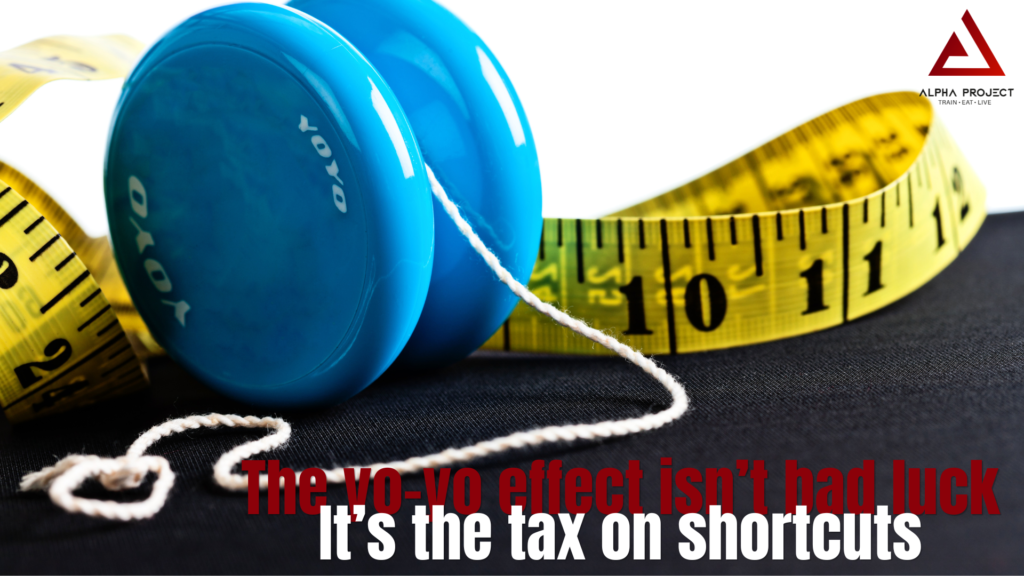
We call it the “yo-yo effect,” treating it like a stroke of bad luck or a flaw in our genetics. But the cold, biochemical reality is much harsher: The yo-yo effect is simply your body penalising you for taking a shortcut.
The Anatomy of a Crash Diet
When you force your body into a radical, uncalculated caloric deficit—eating nothing but salads and dry chicken breasts—your brain doesn’t think, “Brilliant, we’re getting ready for beach season.”
Your brain thinks you are trapped in a famine.
As a survival mechanism, your body systematically shifts into defense mode to protect its energy reserves:
- Muscle Wasting: Muscle tissue is metabolically expensive. It requires calories just to exist. To lower your daily energy demands, your body burns your muscle mass for fuel instead of your fat stores.
- Metabolic Slowdown: Your baseline metabolism plummets. Your body learns to survive on fewer and fewer calories, meaning your daily limit to maintain your weight becomes incredibly low.
- Hormonal Chaos: Your hunger hormones (ghrelin) skyrocket, while your fullness signals (leptin) vanish. You become chronically hungry, irritable, and obsessed with food.
By the time you give up on the crash diet, you have effectively turned yourself into a smaller, softer version of your former self with a crippled metabolism.
The Rebound: Paying the Fine
The moment you go back to eating normally, your broken metabolism cannot cope with the sudden influx of food. Because you lost valuable muscle tissue during the crash phase, your body no longer has the machinery to burn off those calories efficiently.
Worse yet, your system enters hyper-storage mode. Anticipating another “famine,” it converts every spare calorie into fat, particularly around your waist and midsection.
You didn’t lose weight; you simply rented a smaller body for a month, and now the lease is up with heavy interest rates.
The High-Performance Alternative
An elite physique cannot be built using emergency tactics. If you want a permanent transformation that actually stays with you when you leave the house or head out for a business dinner, you must ditch the quick-fix mindset.
Real body transformation requires a calculated, strategic approach:
- A Controlled Deficit: Drop your calories by a marginal fraction, not a cliff. You want to coax the fat off your frame, not terrify your metabolism into shutdown.
- Heavy Resistance Training: You must give your body a definitive reason to keep its muscle mass. Lifting heavy weights signals that muscle is essential for survival, forcing your system to pull from fat tissue instead.
- Patience and Systematisation: If it took you five years of late-night takeaways and desk-bound stress to put on 3 stone, don’t expect to resolve it cleanly in three weeks.
Stop looking for the emergency exit. Commit to a sustainable, data-driven system that builds a permanent standard of health and physical power.
[STOP CRASH DIETING — SYSTEMATIZE YOUR TRANSFORMATION WITH THE ALPHA PROJECT]